Gen Z spends nine hours a week gaming. Who remembers the ads?
A ghost in Mario Kart, a passenger bound for Pizza Hut and a virtual pressure washer tell us more about a player’s attention than a stopwatch can. They also suggest a fairer test for the brands buying their way onto the screen.
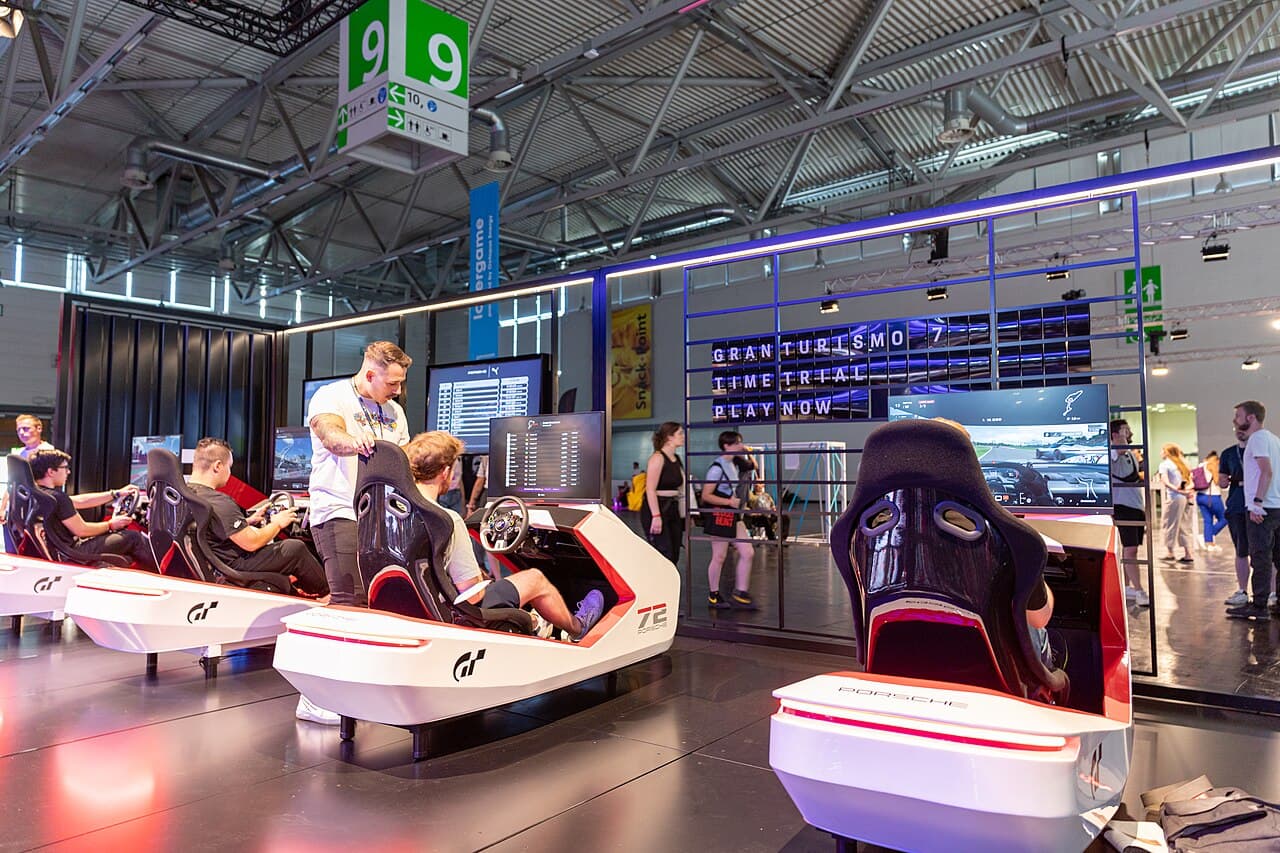
Look at the closest racing seat in the photograph. From behind it, you can read “Porsche” across the white shell. The person in the seat has a splendid view of the road and no view at all of the lettering on the back of their own seat. Move a few feet across an exhibition hall and the answer to who saw the sponsor? changes. Everyone is still at the same event.
Researchers devised a remarkably good way to test that intuition. They asked 88 undergraduates to play or watch a custom-built racing game, using either a flat screen or virtual reality. The spectators were the most likely to remember the billboards. The drivers, busy getting the car around the course, were the least likely. Switching from a flat screen to VR produced no detected difference in brand recall or recognition. The expensive-looking part of the setup made less difference to this particular outcome than the humble question of who had the controls. Read the racing-game experiment
That finding deserves a place alongside the figure that prompted this column. In September 2026, Gameloft for brands and GWI reported that Gen Z spent an average of nine hours and 11 minutes a week gaming. An October Marketing-Interactive article, written in collaboration with Gameloft for brands, made the case that advertisers have underestimated young people’s capacity to pay attention. We think it’s worth taking that case one question further. Once a game has earned those hours, what reason does the player have to spend even a few seconds of them thinking about its sponsor? Gameloft and GWI research · The partner article that prompted this column
How much time does Gen Z spend gaming?
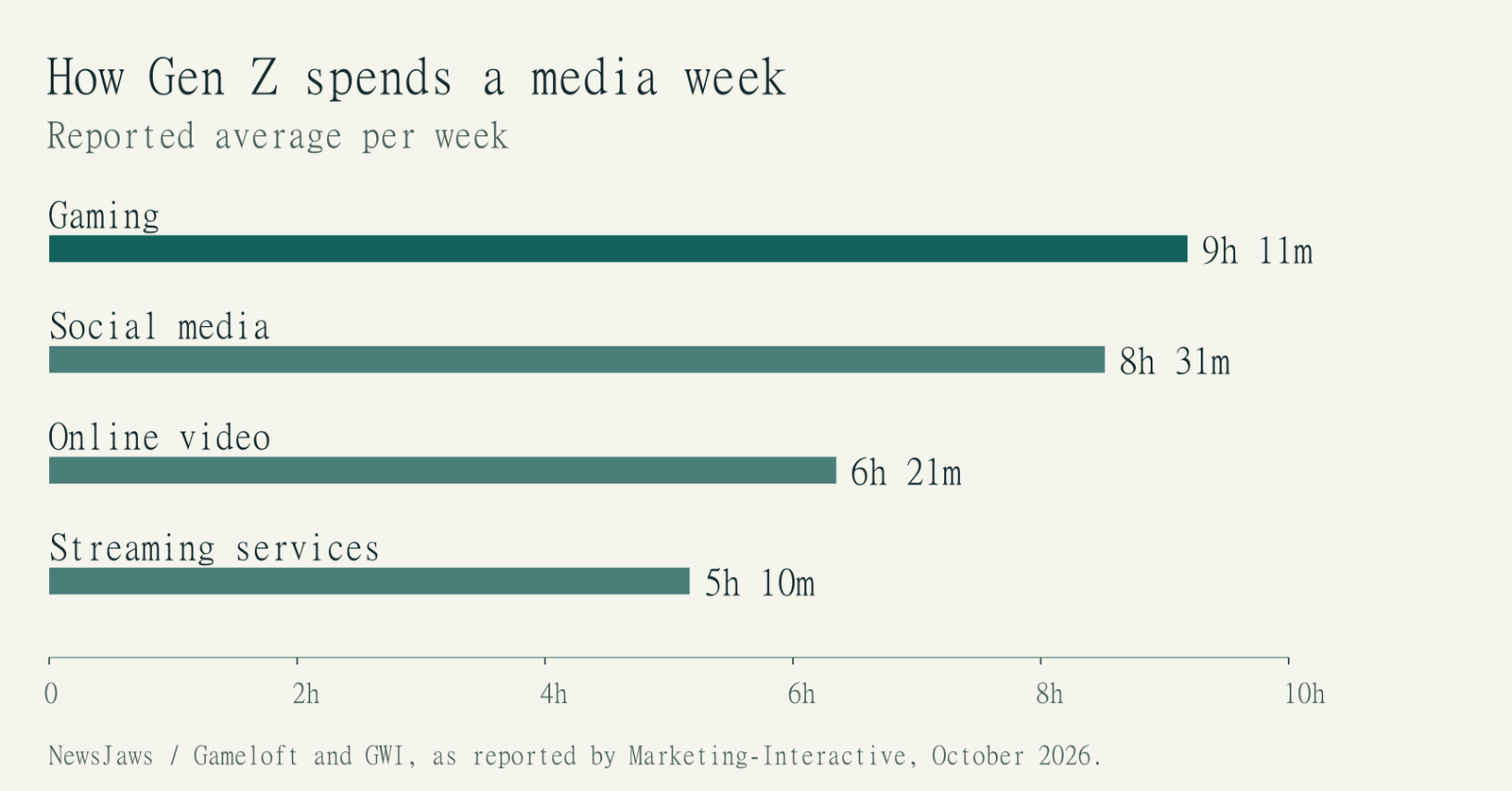
Gaming leads social media on these figures by 40 minutes a week. Divide by seven and the difference comes to five minutes and 43 seconds a day. That is our calculation, assuming an even spread, and it puts the horse race between the two media in perspective. A headline about gaming overtaking social feeds sounds like a sweeping change in allegiance. On an ordinary Tuesday the size of the average gap is roughly the time it takes to put the kettle on, make tea and find where you left the controller.
Now try making 551 minutes out of two entirely different weeks. One player spends nearly all of Saturday in a tournament. Another opens the same game for a handful of short sessions every day. Give them the same total and they will stand at exactly the same height on a chart. For a friend hoping to play with them, a designer deciding where to place a save point or a sponsor choosing when to interrupt, those weeks have almost nothing in common. A weekly average can tell you where to look. It cannot tell you what was happening when you got there.
The report’s other frequently cited figure, 76%, answers a narrower question. That share of surveyed Gen Z COMBO! mobile players described themselves as mostly or fully focused in their most recent session. Gameloft combined GWI research with a separate in-game survey of 152 Gen Z mobile gamers in 14 markets in the second quarter of 2026. The 152 belongs to that in-game survey. A respondent rating their own concentration has told us something valuable about how it felt to play. They could give precisely the same rating after remembering every billboard or after missing the lot. Gameloft’s methodology and focus question
The fastest ghost in Mario Kart was a bad opponent
During the making of Mario Kart Wii, Nintendo’s developers had a problem that anybody who has played an older sibling will recognise. Their system could send a racing “ghost”, a recorded run that another player could chase around the track. In principle, a beginner could line up against the fastest ghost in the world. As the developers explained to Nintendo president Satoru Iwata, the expert would disappear almost immediately. They made it easy to download ghosts whose times were close to the player’s own. Nintendo’s developer interview
There’s a lovely bit of modesty in that decision. Put a world record on a menu and you have an impressive number. Put a slightly faster kart a few lengths ahead and you give someone a plan for the evening. Now they can see where the other driver brakes. They can try the inside line, make a mess of it and still have a particular bend to look forward to on the next lap. The unit that matters to that player might be the tenth of a second they hope to win back. From outside the room all anybody sees is another twenty minutes of screen time.
This is also why the generational label gets in the way. A parent trying to beat a personal best set years ago and a teenager trying to catch a friend can understand each other perfectly well here. Designing for that shared pleasure requires a pretty intimate knowledge of the game. Buying an audience described as “Gen Z” requires none. We would give more credit to a sponsor that paid for a genuinely good ghost challenge than to one that simply managed to hang its name over every bend.
Sometimes the friend is the reason to log in
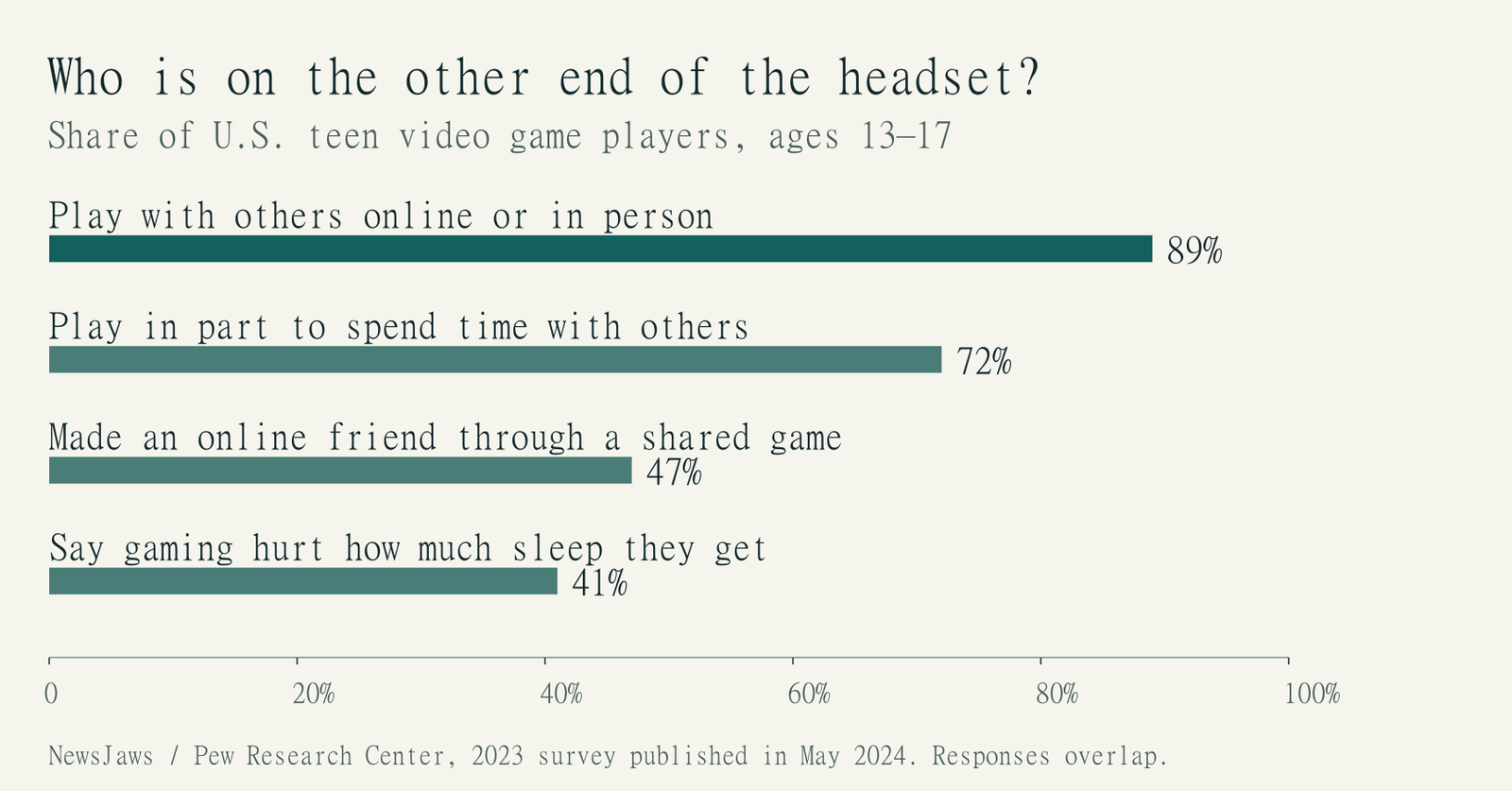
The number we’d linger over is 47%. Nearly half of U.S. teen players in Pew’s survey said they had made a friend online through a game they both played. There’s a world of difference between finding an absorbing way to kill time and finding somebody who will notice if you don’t turn up on Friday. A parent hearing half a conversation through a bedroom door might reasonably ask why the game can’t be paused. Sometimes the answer is that three other people have finally found an evening they can all make.
That loyalty can come at a cost. In the same survey, 41% of teen players said gaming had hurt how much sleep they got. Pew’s published figures don’t tell us how many of the young people who made a friend also lost sleep. Both experiences fit easily into one evening. An extra round can mean a few minutes with someone you miss and a thoroughly miserable alarm the next morning. A company that counts the extra round as a commercial success has measured something real. The teenager has to live with both halves of it. Pew’s findings on friendships and sleep
The practical question for advertisers is when an interruption lands. Imagine four friends have made it into the same lobby. An ad runs while everyone is choosing equipment and conversation carries on. Now put the same thirty seconds on one player’s screen just as the other three are ready. The advertiser receives one impression either way. In the second version, three people who never saw the ad have also paid for it with their time. A campaign report that counts only the person looking at the screen will miss the people beginning to sigh into their microphones.
Even washing a virtual wall can hold someone’s attention
One of the most interesting pieces of gaming research involves an activity that sounds like a chore because it is one. In PowerWash Simulator, the satisfaction lies in turning a dirty surface clean, strip by strip. Researchers analysed 162,325 in-game mood reports from 8,695 players across 67,328 sessions. They measured how people felt near the start and during play. Average reported mood was 0.034 higher on a scale from zero to one during play, with most of the increase occurring in the first 15 minutes. It was a modest shift observed in one game. The researchers explicitly left open whether playing caused it. Oxford research record and study abstract
Why put a pressure washer in a story about advertising? Because the researchers went to the trouble of asking what was happening inside the session. A clock could have run quietly beside all 67,328 of them and never found that small change in mood. A glimpse of clean paint appearing under grime is also a useful corrective to the assumption that every game competing for young people must be louder, quicker or more frantic. You can give somebody a reason to stay by letting them finish one small, legible job in peace. Any sponsor of that moment should think hard before buying a sound effect.
Why a Pizza Hut in Crazy Taxi is easier to explain than a billboard
In Sega’s original arcade game Crazy Taxi, a passenger could ask for a lift to Pizza Hut. A restaurant that would ordinarily be scenery became the answer to a pressing question. Where am I taking this person? You could leave the arcade with a head full of shortcuts and that restaurant woven into the geography. We can’t put a recall percentage on it. What we can do, a quarter of a century later, is explain exactly why a player had a reason to read the name. The Guardian’s retrospective and interview with director Kenji Kanno
A separate racing-game experiment tested a related idea. Players who could select a branded car or racetrack remembered familiar brands better than players who encountered them on a billboard. That advantage showed up only for brands already familiar to the participants. If your company is introducing itself for the first time, the distinction matters. A driver selecting a car may already have years of memories attached to the badge. Giving a new badge the same slot in the menu buys it the same patch of screen, while the older brand brings all those memories along for free. Study of player choice, familiarity and brand recall
That makes for a useful little parlour game. Think of a brand you remember from playing years ago. Can you also remember what you were doing when you saw it? If the answer is delivering a passenger, picking a car or trying to beat a time, the designer has supplied a verb. If the only verb anyone can come up with is “appeared”, we’d want a pretty good price for the billboard.
What did Samsung get from 251,000 races?
Samsung sponsored a limited-time Asphalt Legends event with device rewards. The Marketing-Interactive partner account reports 251,000 races and says 21% of players participated. These are the campaign’s reported figures. Completing a race takes more effort than scrolling past a post, and getting players to enter is a worthwhile achievement. The question we would ask at the budget meeting is simple. How many people came back for race number two? The Samsung campaign account
Here is a piece of arithmetic worth doing before that meeting. You could produce exactly 251,000 races with 251,000 people racing once, or with 25,100 people racing ten times each. Neither scenario is an estimate of Samsung’s audience. They are two completely different successes hiding inside the same counter. One suggests extraordinary breadth and gives a sponsor reason to ask why nobody returned. The other suggests a much smaller crowd found something worth repeating. The participation percentage helps, but without a count of eligible players and a distribution of repeat races, we can’t reconstruct which experience the players had. Nor does either number establish what happened to device sales.
If we could add one question to the event, we would ask players the next day who put it on, before showing them a list of names. Then we would give them a box to describe the moment they remembered. Somebody who can describe a last-corner overtake in exquisite detail and draws a blank on Samsung has given two different teams honest feedback. The game designers made a memory. The sponsor gets to decide whether funding a good afternoon for players was worth the price even to people who forgot its name.
There’s a comparable choice in our own business. When somebody opens a match report to find the score, we can put it in the first sentence or bury it under seven paragraphs about the atmosphere. The second version might buy the site another minute. The first gives the reader a reason to trust us with the next result. That’s the bargain we’d like to see games and their sponsors make with players too. Give the beginner a ghost they can catch. Let the friends finish their race. If they remember who made that evening a little better, that is attention a sponsor can reasonably claim to have earned.
What this story rests on
10 sources from 10 organisations: 1 newspaper or magazine, 9 news outlets.
- 1Porsche racing simulators at Gamescom 2022dronepicr via Wikimedia Commons · commons.wikimedia.orgNews outlet
- 2Creative Commons Attribution 2.0 GenericCreative Commons · creativecommons.orgNews outlet
- 3Did You Notice the Ads?Journal of Interactive Advertising via University of Illinois · experts.illinois.eduNews outlet
- 4Gen Z and Gaming researchGameloft for brands and GWI · gameloft.comNews outlet
- 5If Gen Z can game for nine hours, then attention isn’t the problemMarketing-Interactive Partner Insights with Gameloft for brands · marketing-interactive.comNews outlet
- 6Mario Kart goes globalNintendo, Iwata Asks · nintendo.comNews outlet
- 7Teens and Video Games TodayPew Research Center · pewresearch.orgNews outlet
- 8Affective uplift during video game playOxford Research Archive · ora.ox.ac.ukNews outlet
- 9Sega’s pop-punk classic Crazy Taxi at 25The Guardian · theguardian.comNewspaper or magazine
- 10Investigating the Effects of Active Control on Brand Recall Within In-Game AdvertisingJournal of Interactive Advertising · doi.orgNews outlet
AI-assisted article checked against the listed sources. NewsJaws did not conduct interviews or attend the reported events.
Researched and drafted with AI tools from these sources, then checked against them paragraph by paragraph before publication. How we work · Everyone we cite · Report an error